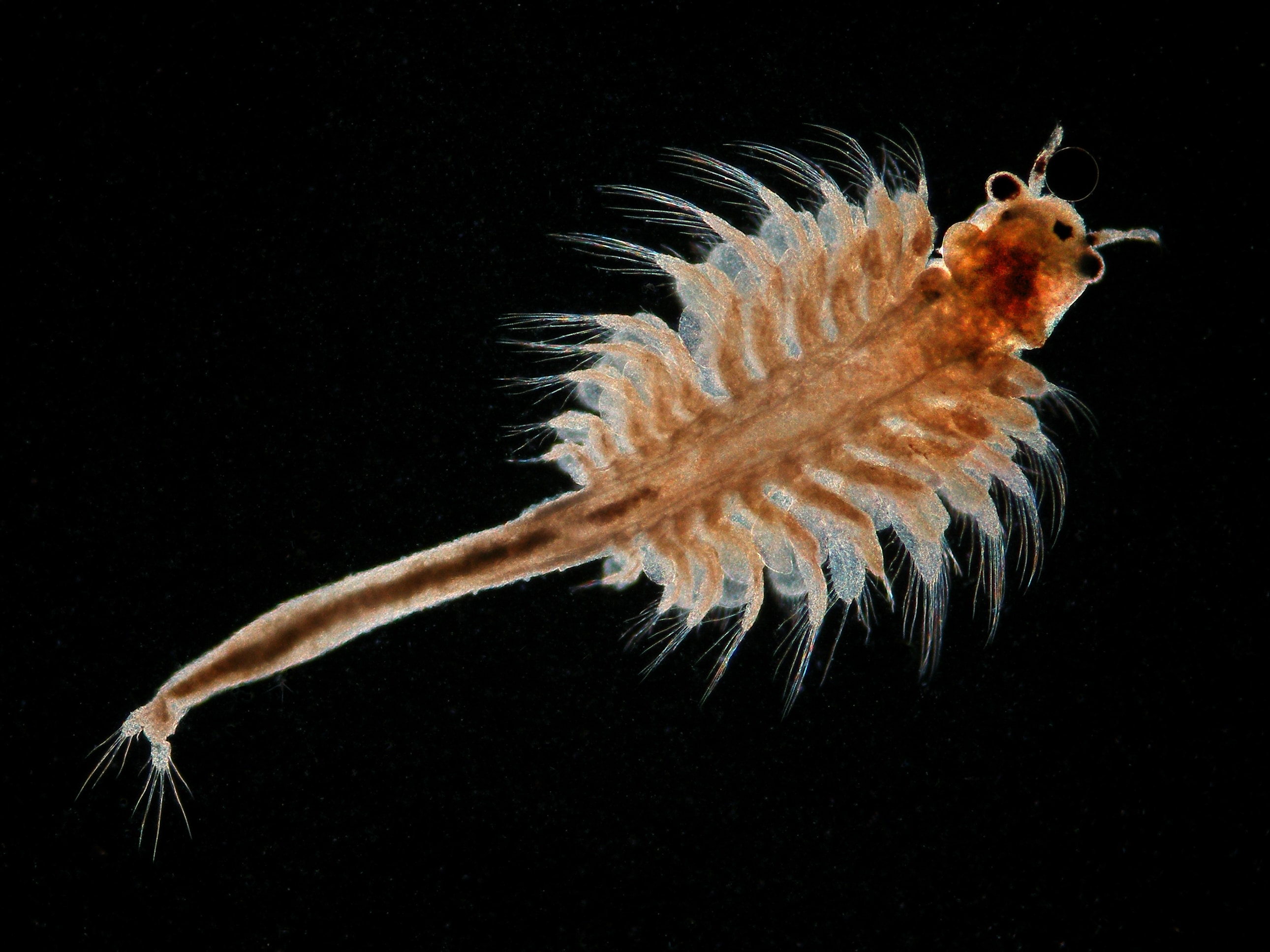
Artemia franciscana
Artemia franciscana
A brine shrimp adapted to hypersaline environments and widely used to study osmoregulation, development, stress physiology, and comparative genomics.
Dataset Statistics
Overview
Artemia franciscana (brine shrimp) is a branchiopod crustacean adapted to hypersaline environments. Its exceptional tolerance to salinity and environmental stress, together with its distinctive developmental biology, has made the species widely used in studies of osmoregulation, development, stress physiology, and comparative genomics.
The current data release combines a RefSeq genome resource with curated transcriptomic datasets from multiple studies and experimental conditions. Genome annotation, sequence search, genome browsing, and expression datasets support integrated exploration of the A. franciscana genome, gene expression, and biological responses across developmental and environmental conditions.
Reference Genome and Annotation
| Item | Value |
|---|---|
| Genome assembly | GCF_032884065.1 (ASM3288406v1) |
| Gene annotation | NCBI RefSeq GCF_032884065.1-RS_2024_06 ① |
① Gene search supports 2,789 additional distinct aliases from NCBI Gene and UniProtKB/Swiss-Prot.
Most genes in the current RefSeq annotation use NCBI provisional locus names in the form LOC followed by a numeric identifier (for example, LOC136038375). A smaller subset has a descriptive gene name; the LOC naming reflects the current annotation status and does not indicate a problem with the genome resource.
Data Sources
Single cell data
| StudyID | Year | Journal | Title | PMID | Accessions | Sample | GeneID handling |
|---|---|---|---|---|---|---|---|
| 2024_PLoSGenet_Vicoso | 2024 | PLoS Genet | Single-nucleus atlas of the Artemia female reproductive system suggests germline repression of the Z chromosome | 39213449 | PRJNA1128544 ; ISTA REx | Female reproductive system, integrated RNA (20,109 nuclei) | Converted (54.3% of author features; 78.9% of raw counts) |
GeneID handling describes how single-cell gene identifiers are connected to the current portal database. Original retains the author identifier system. Converted retains the author matrix while connecting confidently mapped features to the current NCBI GeneID set; the percentage reports the retained fraction of author features, and unmatched features are excluded. Rebuilt regenerates a matrix from raw reads against the current reference; expression values, detected features, and cell annotations can differ from the author workflow.
2024_PLoSGenet_Vicoso is Converted: sequence-based assignments connected 19,760 of 36,378 author features (54.3%) to NCBI GeneID and retained 78.9% of raw expression counts. Ambiguous assignments were excluded, and features assigned to the same RefSeq gene were aggregated. The author package also contains ATAC data for two Multiome replicates; these scATAC data are not displayed because their peak coordinates and gene-activity identifiers have not been assessed against the RefSeq reference.
Bulk data
| StudyID | Year | Journal | Title | PMID | Accessions | Sample |
|---|---|---|---|---|---|---|
| 2025_MolBiolEvol_Vicoso | 2025 | Mol Biol Evol | Chromatin Landscape Is Associated With Sex-Biased Expression and Drosophila-Like Dosage Compensation of the Z Chromosome in Artemia franciscana | 40202086 | PRJNA1150095 | CUT&Tag profiling of seven histone marks in female/male heads and gonads; 62 runs summarized into 28 group-level tracks |
| 2025_PLoSGenet_KellerValsecchi | 2025 | PLoS Genet | Convergent evolution of H4K16ac-mediated dosage compensation in the ZW species Artemia franciscana | 41066503 | GSE289905 ; PRJNA1225277 ; PRJNA1197400 | Embryo and adult RNA-seq plus H4K16ac CUT&Tag and IgG controls; 14 RNA-seq runs and 42 CUT&Tag runs |
| 2024_Genes_Hao | 2024 | Genes | Integrating ATAC-Seq and RNA-Seq Reveals the Signal Regulation Involved in the Artemia Embryonic Reactivation Process | 39202442 | GSE249417 ; GSE254935 ; GSE248452 ; GSE254934 ; PRJNA1049008 ; PRJNA1072659 ; PRJNA1044056 ; PRJNA1072660 | Parthenogenetic Artemia RNA-seq and ATAC-seq at 0 h, 30 min, and 5 h after diapause release; 9 RNA-seq runs and 9 ATAC-seq runs; cross-species alignment to the A. franciscana reference |
| 2024_AquacultureReports_Junprung | 2024 | Aquaculture Reports | Thermal adaptation affects expression and regulation of metabolism-, stress-, and immune-related genes in Artemia franciscana populations | - | PRJNA1102714 ; DOI | Nauplii from thermotolerant and control populations, plus CF12 after non-lethal heat stress; three single-end RNA-seq runs |
| 2023_PNAS_Artigas | 2023 | PNAS | A Na pump with reduced stoichiometry is up-regulated by brine shrimp in extreme salinities | 38079564 | PRJNA1043900 | Whole-animal RNA-seq at 250 mM, 2 M, and 4 M osmolarity; 8 runs |
| 2022_PRJNA853706_Yang | 2022 | NCBI BioProject | Comparative transcriptome of the male and female Artemia franciscana (Kellogg 1906) | - | PRJNA853706 ; SRP383959 | Whole-body male and female RNA-seq, three biological replicates per sex; 6 runs |
| 2022_MarGenomics_Park | 2022 | Marine Genomics | Transcriptomic analysis of brine shrimp Artemia franciscana across a wide range of salinities | 34965493 | PRJNA649341 | Adults acclimated for 2-4 weeks at 35, 50, 100, 150, and 230 practical salinity units (PSU) |
| 2021_BiosciRep_Park | 2021 | Biosci Rep | Whole genome survey and microsatellite motif identification of Artemia franciscana | 33629105 | PRJNA449186 ; SRP139396 | Whole-body RNA-seq from nauplii, juvenile, adult, male, and female samples; 5 runs |
Genome Browser
Interactive genomic data visualization and exploration using JBrowse 2
Loading JBrowse 2...
Please wait while we load the genome browser
Gene Browser
Interactive gene expression analysis and multi-omics data exploration using Dash
BLAST Search
Find similar sequences in the Artemia franciscana database using SequenceServer