Lab Resources
Website:
Citation:
- Yang H, Wang Z, Shan Z, Shang H, Jiang P, Li Y, Tu Q. 2026. miniODP: a reusable framework for building multi-omics resources in understudied organisms. bioRxiv. doi:10.1101/2024.01.06.573815
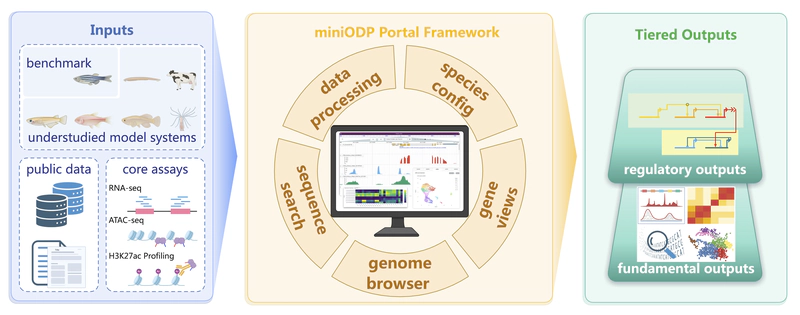
Building multi-omics resources for understudied organisms requires assay selection, public-data curation, gene identifier handling, portal deployment, and visualization, yet these tasks are rarely packaged into a reusable framework. To fill this gap, we developed the mini Omics Data Portal (miniODP), which combines species pages, gene-centric modules, genome browsing, and sequence search with configuration files, species onboarding workflows, and demonstration data for self-deployment. Alongside the software, we propose miniENCODE core assays: a reduced RNA-seq, ATAC-seq, and H3K27ac profiling set for regulatory analysis. Current miniODP includes seven species, covering 3,568 bulk runs, 3.61 million cells, and 1,865 genome-browser tracks. We welcome collaborations with organism-specific communities interested in deploying miniODP on their own servers or hosting curated multi-omics datasets through our platform. Please contact us to discuss potential collaborations.
Website:
- https://tulab.genetics.ac.cn/medaka_omics/
- 2026/07 upgrade to https://tulab.genetics.ac.cn/miniodp/
Download:
Citation:
- Li Y, Liu Y, Yang H, Zhang T, Naruse K, Tu Q. 2020. Dynamic transcriptional and chromatin accessibility landscape of medaka embryogenesis. Genome Res 30: 924–937. doi:10.1101/gr.258871.119
Here we report a dynamic transcriptome landscape of medaka embryogenesis profiled by long-read RNA-seq, short-read RNA-seq, and ATAC-seq. Integrating these datasets, we constructed a much-improved gene model set including about 17,000 novel isoforms and identified 1600 transcription factors, 1100 long non-coding RNAs, and 150,000 potential cis-regulatory elements as well. We built a user-friend medaka omics data portal to present these datasets. This resource provides the first comprehensive omics datasets of medaka embryogenesis. We term these three assays as the minimum ENCODE toolbox and propose the use of it as the initial and essential profiling genomic assays for model organisms that have limited data available. This work will be of great value for the research community using medaka as the model organism and many others as well.
Download:
Citation:
- Li Y, Yang H, Zhang H, Liu Y, Shang H, Zhao H, Zhang T, Tu Q. 2020. Decode-seq: a practical approach to improve differential gene expression analysis. Genome Biol 21: 66. doi:10.1186/s13059-020-01966-9
It is often the case that inadequate numbers of biological replicates are utilized in differential gene expression analysis. We describe an easy and effective RNA-seq approach using molecular barcoding to enable profiling a large number of replicates simultaneously. This approach significantly improved the performance of differential gene expression analysis. Using this approach in medaka fish (Oryzias latipes), we discovered novel genes with sexually dimorphic expression, and genes necessary for germ cell development. We appeal that the common practice of using three replicates in differential gene expression analysis should be abandoned.